One record for every trip
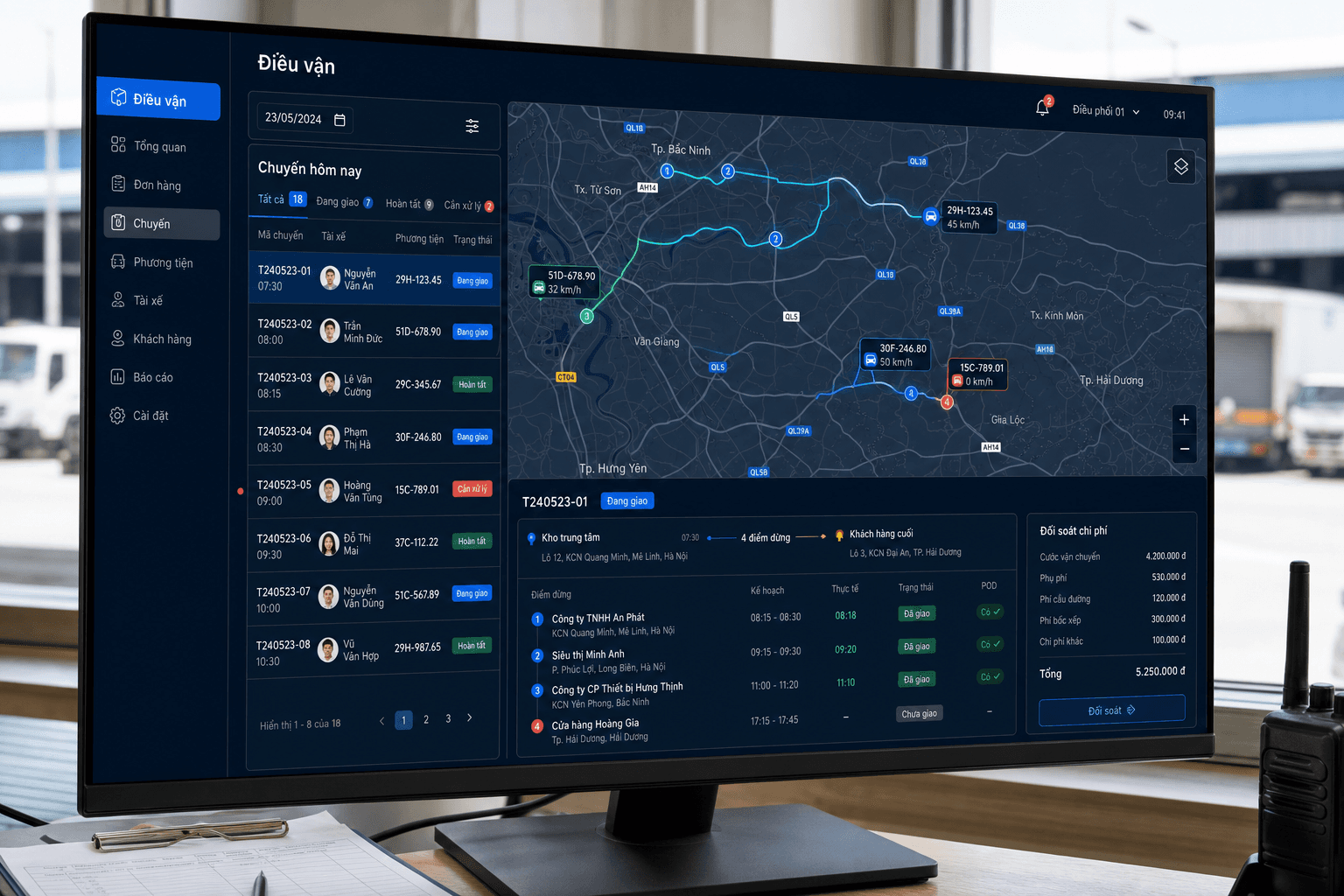
Assignments, route changes, statuses, conversations and documents share one trip code and an auditable history.
Domestic transport operator
Easy Alo built a transport operations system connecting dispatch, drivers, documents and reconciliation, giving every trip one continuous record instead of a trail of spreadsheets and calls.
 Featured caseDomestic transport operator
The operator's identity, routes and vehicle details have been changed. Product imagery is an illustrative reconstruction of delivered workflows and does not contain live operating data.
Challenge
A trip was created in a spreadsheet, assigned by phone, updated through messages and completed with a folder of paper documents. When a delivery point changed or a vehicle had trouble, dispatchers could not be sure which update was current. At month end, finance had to match tolls, handling and surcharges to each trip, while customers phoned for status because there was no self-service view.
Solution
Easy Alo first standardised the trip lifecycle with the operations team. Each trip carries a code, route, vehicle, driver, stop list, timestamps and supporting documents. Dispatchers work from today's trips and a route map; drivers update pickup, arrival, delivery and proof-of-delivery milestones through a focused mobile flow. Completed trip data becomes the starting point for reconciliation rather than being entered again.
Inside the product
Assignments, route changes, statuses, conversations and documents share one trip code and an auditable history.
The workspace surfaces delayed trips, long stops, missing proof of delivery and incomplete costs instead of asking dispatchers to call every driver.
Expected and additional costs follow the journey, allowing finance to verify evidence instead of reconstructing events at period end.
Delivery
We recorded where data was created, who needed it and when capturing it became a burden.
Planned, actual and exception states were separated, with clear editing rights and audit requirements.
Trip creation through POD and reconciliation was validated before adding wider reporting and integrations.
The team supported early shifts through poor connectivity, driver changes, partial deliveries and late documents.
Results
Shipment volume, delivery time and cost figures remain the client's operating data. Easy Alo publishes the process and delivered system capability instead of estimating improvement percentages.
Next step